- The road to time & financial freedom
- Posts
- #3: To code or not to code
#3: To code or not to code
Should you hire a dev or start yourself - let's see.

Alexandre Vandermeersch
February 09, 2024
Hello everyone,
First, welcome to the new subscribers! Glad to see the newsletter growing.
If you read this, you’re maybe convinced that tech has not only the power to change the world, but also your life. And you’ve realized that if you’d like build a powerful tool, you may have to get your hands dirty or hire a developer. But that costs money, right ?
Let’s see.
To code or not to code ?
That’s the question, right ?
If you’re into the tech sector, you’ve probably seen the raise of the “no-code” movement. The question is: can you actually build apps if you don’t know how to code, but with the help of a visual interface ?
Of course, this is quite attractive for solo founders or entrepreneurs - a great way to validate an idea without committing too much money or going through the pain of finding a technical cofounder.
Over the last week, I’ve decided to build a prototype for my email assistant, Jalon, with a no-code solution called n8n.io. And the good news ? It actually works!
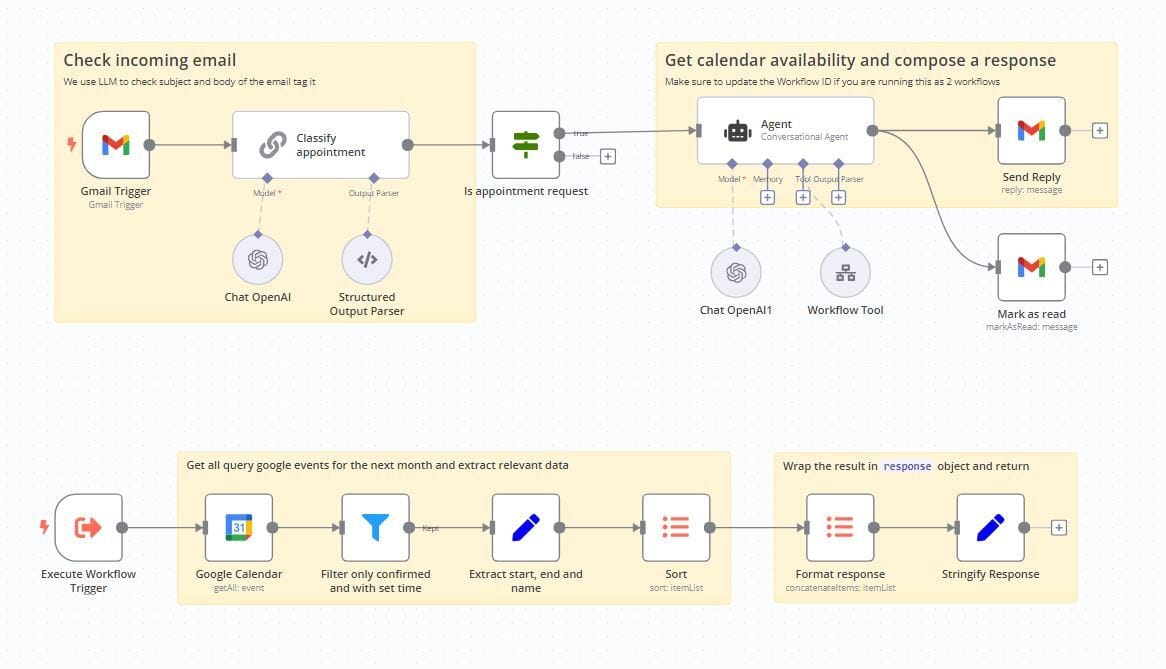
This is an example of a workflow in n8n, from which I took inspiration.
There are other tools available to create no-code solutions, including those with a Web interface, such as bubble.io . However, some tools like make.com and zapier.com only focus on the workflow aspect. On the other hand, there are emerging AI-centric solutions like tryleap.ai . Personally, I have found n8n to be the most user-friendly and extensive tool for my needs. It even includes the latest tools from OpenAI and allows for the addition of code when necessary. All of this comes at a reasonable price.
Now, you may wonder if you can simply add a nice front-end with a website builder and a Stripe link to these solutions. Unfortunately, for most solutions, this is not possible. For instance, n8n is not multi-tenant, meaning that all users of n8n will share the same "space", which is not acceptable for a SaaS. However, there are other solutions available that offer an "app integration” (ie you can call the workflows from your app and integrate seamlessly with many users) but there are quite expensive and then, I am not sure I would use them. Because they all have limitations, and at some point I might get blocked. But others have done it.
Yet, doing this prototype enable to see (1) is this doable ? (2) is this useful ? (3) are my expectations realistic? On this last point, and especially for AI apps, one of the key aspects is to be realistic. No, no AI app will spit out a full go-to-market strategy for your start-ups in 72 slides, even if you wish it hard (some people tried, though).
With a prototype in no-code, you can iterate fast without relying on a developer and tune the solution to the point of (1) most important feature(s) for the customer (based on your research - it might be you if you are in the target) and get those “alpha users” to confirm it (2) doable. Ideally, you should launch with 1 feature, well executed (vs 5 poorly). So I am resisting the urge to “pack stuff” and will focus on 1 or 2 for an AI assistant: filter emails and give recommendations of actions.
Watchout: it’s not that easy. The output format of one step needs to match with the input of the next step (string, JSON, array, etc.), which caused me some headache. You need to think of algorithms so if you never programmed in your whole life, it might be challenging. I’ve used also their forums but ChatGPT was quite useful at some point to help me out. Eventually, I learned more doing this on JS, OpenAI API, prompt engineering than any class.
Oh, one more point: AI can be expensive. So if you think about AI, it’s also good to run a prototype in order to figure out how much it will cost you per trial. For me, it costed me at some point about 0.3€ per email… Imagine doing this for hundreds or thousands of emails. You can always optimize but unleashing the full power of GPT-4 (most expensive model of openAI) for free on the Internet could be dangerous.
I wish I provided you some inspiration and removed some of the fear of getting started. Because you can always watch another video or read another book, but nothing supersedes the joy of doing. This is also where true learning happens.
Let’s get started ?